| Brand Name: | HongCe |
| Model Number: | HC-HPC3000 |
| MOQ: | 1 Set |
| Price: | Negotiation |
| Payment Terms: | T/T,L/C |
| Supply Ability: | 5 Sets per Month |
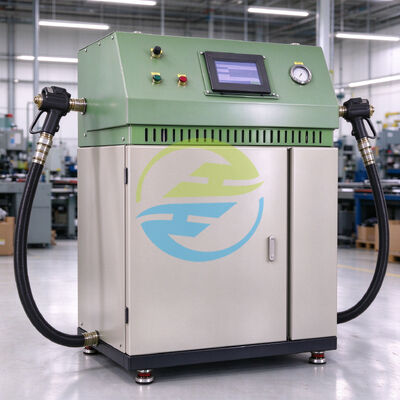
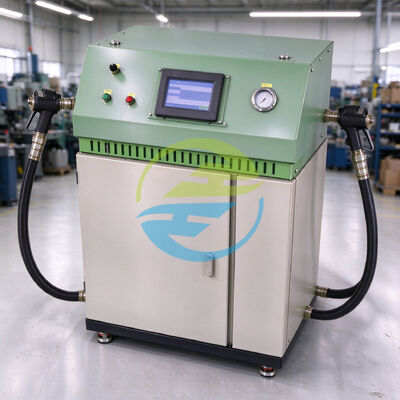
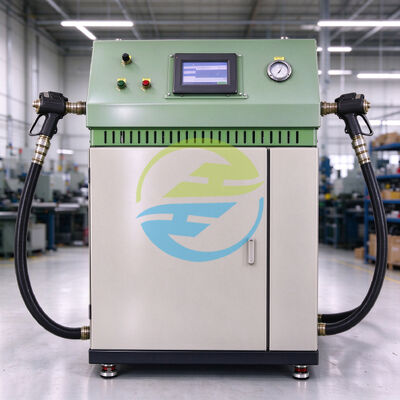
Heat pumps and chiller units often need more than a single fixed charge. This equipment lets engineers build their own charging program with several stages, different quantities per stage and hold times between them, so the same machine can follow the charging procedure of each unit model instead of forcing the procedure to match the machine.
It is a single-station, recipe-driven charger for heat pump water heaters, monoblock units, chillers, air handling units and condensing units. The charging range reaches 30 kg on a 60 kg scale, liquid, vapour and combined charging are supported, and the program can hold up to eight stages. Separate parameters can be stored for cooling mode and heating mode charging — the point most fixed chargers cannot handle when a heat pump is commissioned in either mode.
Each stage has its own target and its own limits, and the values below are monitored during the stage rather than only at the end of the cycle:
| Measured item | Range / resolution | How it is measured | What it tells the operator |
|---|---|---|---|
| Charged weight per stage | 50 – 30000 g total, 1 g resolution | 60 kg load cell with per-stage tare | How much has entered the unit in the current stage against the stage target |
| Total charge accuracy | ±0.3% of set value | Closed-loop control with trim fill at the end of each stage | Whether the finished unit matches the nameplate charge |
| Number of completed stages | Up to 8 programmable stages | Program sequencer with hold timers | Which step of the charging procedure the unit has reached |
| Charging mode | Liquid, vapour or combined | Mode selected per stage in the recipe | Whether the unit is being charged in the state its design requires |
| Line pressure during charging | Displayed and compared with recipe limits | Pressure transmitter on the manifold | Restriction in the circuit, cylinder empty, valve partly closed |
| Vacuum level before charging | Displayed with vacuum limit per recipe | Vacuum sensor, interlocked with the program | Whether evacuation is complete before the first stage is allowed to start |
| Recipe version in use | Stored per program, import and export by USB | Recipe library in the controller | Whether every station in the plant is running the same approved program |
The heart of the machine is a program sequencer that runs up to eight stages, each with its own quantity, hold time and charging mode. A heat pump with a long liquid line can be charged in two or three steps with settling intervals between them, which keeps the charge consistent on units that would otherwise be overcharged if the full quantity were injected at once.
Heat pumps are commissioned in both modes and the required charge differs between them. Instead of one fixed value, the controller stores a parameter set for cooling mode and one for heating mode, so the technician selects the mode and the correct target follows. This is what makes the station usable for a heat pump OEM that tests both modes on the same bench.
Some unit designs require liquid charging through the liquid line, others require vapour charging through the suction side at a controlled rate. The station supports both, and the charging path is chosen per stage in the recipe, along with the flow restriction that keeps the compressor safe during vapour charging.
Programs are stored in the controller and can be exported to a USB stick, so one approved recipe can be copied to every station in a plant or to a service team in the field. Multi-site standardisation then becomes a file copy instead of a retyping exercise, and a recipe revision can be traced to the date it was introduced.
| Parameter | Specification |
|---|---|
| Charging range | 50 – 30000 g |
| Charging stages | Up to 8 programmable stages |
| Charging accuracy | ±0.3% of set value |
| Scale capacity | 60 kg |
| Scale resolution | 1 g |
| Refrigerant types | R410A / R32 / R134a / R290 / R404A |
| Charging mode | Liquid, vapour or combined |
| Interface | USB recipe import and export |
| Power supply | 220 V 50/60 Hz or 380 V three phase |
| Application | Heat pump, chiller, AHU and condensing units |
| Model number | HC-HPC30000 |
| Certification | CE, ISO 9001:2015 |
| Place of origin | Guangzhou, Guangdong, China |
| Brand | HongCe |
The equipment is built for units in the 50 g to 30 kg charge range, which is where most heat pump and chiller production sits:
Large charge stations are usually installed as part of a production line, so support is organised around keeping that line running.
| Support item | What is provided |
|---|---|
| Warranty | Twelve months on controller, 60 kg load cell, pressure transmitter and vacuum sensor, extendable on request |
| Recipe setup | Recipe templates for your first unit models prepared with our engineers at commissioning, so the station leaves the workshop ready to run |
| Remote support | Program building and troubleshooting by video call, with the program file exchanged by email |
| On-site service | Commissioning, operator training and recipe cloning available as an option for line installations |
| Spare parts | Spare parts list and recommended consumables (hoses, couplers, filters) agreed at order stage |
| Calibration | Annual calibration service for weight, pressure and vacuum channels with a certificate for your quality file |
| Documentation | English manual, wiring diagram and PLC address list with every machine |
Long liquid lines and large internal volumes mean the liquid needs time to settle and distribute. Injecting the full quantity at once gives a false weight reading and an inconsistent charge, so the same model ends up charged differently unit to unit. Staged charging with hold times removes that variation.
Yes. The controller keeps a parameter set for cooling mode and one for heating mode, and the technician selects the mode before the cycle. For a heat pump OEM that tests both modes, this avoids maintaining two separate stations.
Yes, up to eight stages per program and several programs stored in the controller. Changeover is a recipe selection, not a mechanical change, provided the charge stays inside the 30 kg range and the hose and coupler set suits the refrigerant.
The recipe library is exported to a USB stick and imported into the other stations, so a new or revised program is distributed as a file. The version in use is visible in the controller, which is useful when a charge-related claim has to be traced.
220 V 50/60 Hz is the standard for a single station. For higher charging rates or when the line supply is three phase, the 380 V three phase version is normally chosen. Please state the workshop supply and the plug standard when enquiring.
Standard builds are normally shipped within four to six weeks after drawing and recipe approval, and project stations with special hose lengths or interfaces are confirmed at order stage. Fumigation-free plywood packing is used for all exports.
Every unit is delivered with an English manual and a written commissioning checklist. Operator training by video call is included, and an engineer visit for training and recipe building can be added to the order.
| Aspect | HongCe programmable charging equipment | Typical low-cost alternative |
|---|---|---|
| Charging sequence | Up to eight programmable stages with hold times and per-stage targets | One target weight, single injection, no staging |
| Cooling and heating mode | Separate parameter sets stored and selected by mode | One value, recalculated by the technician |
| Charge range | 50 – 30000 g on a 60 kg scale with 1 g resolution | Small bench scale, typically limited to a few kilograms |
| Recipe management | Recipe library with USB export, clone to other stations, traceable version | Parameters set by hand at changeover, no record |
| Vacuum interlock | Charging is blocked until the vacuum limit is reached | Vacuum gauge only, decision left to the operator |
| Suitable unit types | Heat pump, chiller, AHU and condensing units in the same station | Usually one unit type per station |
| Documentation | CE and ISO 9001:2015 documents, drawings, PLC address list | Basic manual, documents supplied on request only |
| Support | Recipe templates and commissioning support from the design engineers | No process support after delivery |
| Advantage | What it means for your project |
|---|---|
| Manufacturer with in-house engineering | Mechanical, electrical and PLC capability in one workshop, so a charging program is engineered for your unit instead of selected from a fixed list |
| Twenty years of charging experience | Roughly half of our output is exported and the stations run in daily production at customer sites |
| Certified production | ISO 9001:2015 certified production and CE marked machines, with certificates supplied together with the unit |
| Recipe-driven design | Several unit models and both operating modes on one station, which reduces the number of chargers a line needs |
| Engineering dialogue before the order | Charge quantities, stage times and interfaces are agreed with the design team, not with a sales desk |
| Service built around production continuity | Spare parts list at order stage, annual calibration and remote recipe support keep the line running |
Guangzhou HongCe Equipment Co., Ltd. has been designing and building test and production equipment in Guangzhou, China since 2003. Roughly half of our annual output is exported, and the machines are used by third-party laboratories, appliance and HVAC factories, and inspection bodies that work to IEC, UL, GB and EN standards. Our slogan states the position we have kept for more than twenty years: industry-leading test equipment, advanced online systems and solutions, anywhere in the world.
The company is ISO 9001:2015 certified, and machines supplied to the EU market carry CE marking. Mechanical fabrication, control cabinet assembly, PLC and HMI programming, refrigerant circuit assembly and final calibration are all done in our own workshop, so a station can be engineered around a customer's production sequence instead of being adapted from a catalogue item. Our engineers keep the refrigerant, pressure and vacuum know-how in-house, which is why questions about charging recipes, leak limits or flammable refrigerant handling are answered by the people who built the machine.
Heat pump and chiller projects are usually quoted with the charging program already drafted for the customer's first unit models, so the equipment arrives able to run production the day it is installed.
About us · Factory and workshop · Quality control · All refrigerant filling equipment · Technical news
Customers comparing this machine usually also look at the following stations from our refrigerant filling equipment range:
Tell us the unit models you charge, the charge weight for each, the number of stages your process needs and whether you charge in cooling mode, heating mode or both. Our engineers will return a program layout, the drawing package and the delivery time.
You can also review the rest of the refrigerant filling equipment range or contact our sales engineers with your line details.