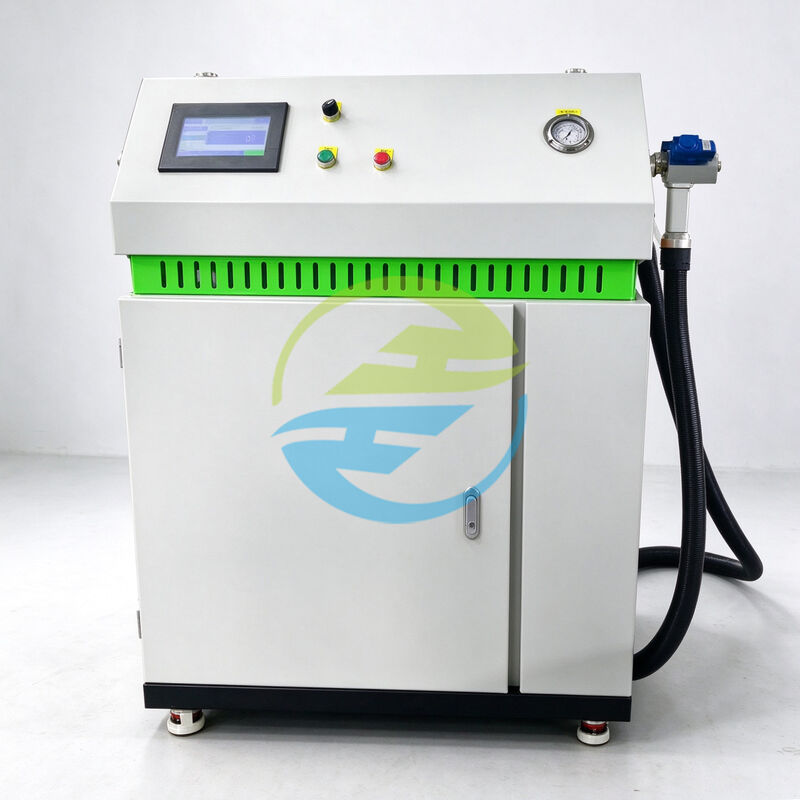
| Brand Name: | HongCe |
| Model Number: | HC-ARC8000 |
| MOQ: | 1 Set |
| Price: | USD 2200-4200 / Set |
| Payment Terms: | T/T,L/C,Western Union |
| Supply Ability: | 50 Sets per Month |
Operators should not have to guess what the machine is doing. This charging system keeps pressure, charged weight and vacuum level on one digital panel throughout the whole cycle, so any deviation is visible while the charge is still running rather than after the unit has been closed. Charging accuracy is held at 0.5 percent of the set value across the full range.
The station runs evacuation, holding, charging and verification as one automatic sequence. A recipe is selected for the unit model, the cycle button is pressed, and the machine repeats exactly the same procedure for every unit. That removes the operator-to-operator variation that normally causes overcharge, undercharge and the warranty claims that follow them. Every cycle is logged with weight, pressure, vacuum and result, and the log can be read out through RS485 or exported to a USB stick for production traceability.
Although it is a charging station, the instrument package makes it a process checker as well. The following values are measured continuously during each cycle, not only at the end of it:
| Measured item | Range / resolution | How it is measured | What it tells the operator |
|---|---|---|---|
| Charged refrigerant weight | 10 – 8000 g, 1 g display | Load cell under the refrigerant cylinder, tare compensated per cycle | Actual charge in the unit, compared with the recipe target in real time |
| Charging accuracy | ±0.5% of the set value | Closed-loop comparison of target weight and measured weight | Whether the unit is repeatable from unit to unit, not only on one sample |
| System pressure | 0 – 5.0 MPa, 0.01 MPa steps | Pressure transmitter on the charging manifold | Blocked hose, non-condensable gas, over-pressure, valve not opened |
| Vacuum level and evacuation progress | 0 – 101 kPa | Vacuum sensor on the pump line | Whether moisture and air have been removed before charging starts |
| Pressure hold (leak pre-check) | Preset hold time and decay limit | Pressure decay comparison over the hold window | A joint or braze that was not sealed, before refrigerant is wasted in it |
| Cycle result and traceability data | Every cycle stored | Controller memory, RS485 or USB export | Which unit was charged, when, with which recipe and what result |
| Alarm and interlock status | Over-pressure, low vacuum, scale drift | Controller logic with relay output | Why a cycle was stopped, and a signal for the line PLC or beacon |
The controller does not simply open a valve and wait for a weight to be reached. Refrigerant enters in a fast fill phase and then switches to a slow trim fill phase near the target, so the liquid column in the hose settles and the final weight is reached without overshoot. This two-step approach is what makes 0.5 percent accuracy repeatable on short charges of a few tens of grams as well as on large ones.
Weight and pressure are read at the same time and compared against the expected curve for the recipe. If the weight rises while the pressure does not, the hose is blocked or the valve is closed; if the pressure rises faster than the weight, the line contains air. The cycle is stopped and the reason is displayed instead of being discovered at the end-of-line test.
Up to one hundred recipes can be stored, each holding charge weight, hold time, evacuation time, vacuum limit, pressure limits and accuracy window. Selecting a recipe by number means the operator cannot change parameters by accident, and different unit models can run on the same station without mechanical adjustment.
The scale is re-zeroed at the start of every cycle, and slow drift of the load cell is compensated over the working day. This matters on a production line where the same station runs for two or three shifts: without it, the first unit of the morning and the last unit of the evening would not be charged to the same weight.
| Parameter | Specification |
|---|---|
| Charging range | 10 – 8000 g |
| Charging accuracy | ±0.5% of set value |
| Pressure display range | 0 – 5.0 MPa with 0.01 MPa steps |
| Vacuum display range | 0 – 101 kPa |
| Recipe memory | 100 programs |
| Interface | RS485 and USB data export |
| Display | Dual-colour digital panel with backlight |
| Power supply | 220 V 50/60 Hz |
| Working temperature | -10 to 45 °C |
| Protection | Over-pressure and scale drift alarm |
| Refrigerant compatibility | R134a / R410A / R32 / R290 / R404A |
| Cycle control | Automatic, single-button start with recipe selection |
| Connection | Charging manifold with quick couplers, hose set supplied |
| Documentation | English operation manual, calibration certificate, wiring diagram |
The station is used wherever the same unit model is charged again and again and the charge weight has to be provable afterwards:
Refrigerant equipment is bought for years of production, so the support behind the machine matters as much as the specification. Every station is delivered with a calibration certificate and a documented test record of the pressure and vacuum channels, which is the starting point for later traceability audits.
| Support item | What is provided |
|---|---|
| Warranty | Twelve months on the controller, load cell, pressure transmitter and vacuum sensor, extendable to twenty-four months on request |
| Commissioning | Remote commissioning support by video call during first installation, with a written checklist for the line technician |
| Spare parts | Recommended spare parts list and a consumables kit (hoses, quick couplers, filters) offered at order stage so a line never waits for a part |
| Calibration | Annual calibration and verification service for the weight, pressure and vacuum channels, with a certificate for the customer's quality file |
| Documentation | English operation manual, wiring diagram and PLC address list supplied with every unit, not on request only |
| On-site service | Engineer visit for installation, training and recipe building available as an option for multi-station projects |
| Engineering support | Technical questions answered by the engineering team that built the machine, normally within one working day |
The standard configuration covers R134a, R410A, R32, R290 and R404A. Because the recipe stores the target weight and the pressure limits, the same station can serve several refrigerants as long as the hoses and couplers are dedicated to each one. We supply separate hose sets where refrigerant mixing has to be excluded.
On a 20 g charge the tolerance is 0.1 g, which is why the station switches to trim fill near the target instead of filling at full flow. For charges below about 10 g we would normally recommend a different scale range; tell us the smallest and largest charge in your production and we will confirm the configuration.
Recipe selection is by number and the parameters sit behind a password level. Operators select a recipe; changing weights, hold times or accuracy limits requires the supervisor level. This is normally required when the same station is used for certified production.
Yes. RS485 is standard and USB export is available for cycle records. If you need MES-level traceability with barcode scanning of the unit serial number, tell us the protocol your line uses and the PLC address list will be prepared for the integration.
The station, a charging hose set with quick couplers, a calibration certificate, an English operation manual, a wiring diagram and an export plywood case. Vacuum pump and refrigerant cylinder are quoted separately unless requested as part of the package.
Standard single-station builds are normally shipped within three to five weeks after drawing approval, and multi-station or custom configurations are confirmed at order stage. Machines are packed in export plywood cases; sea freight for a single station and air freight for urgent projects are both routine for us.
220 V 50/60 Hz is standard. Other single-phase voltages and plug standards are available on request; please state the country and the workshop supply when enquiring.
| Aspect | HongCe automatic charging system | Typical low-cost alternative |
|---|---|---|
| Accuracy verification | Closed-loop comparison of target and measured weight on every cycle, with the deviation shown on screen | Charge stops when the scale reading is reached, no cross-check and no deviation record |
| Pressure and vacuum data | Pressure and vacuum displayed and logged together with the weight | Separate gauges, read by eye, not recorded |
| Recipes | 100 stored recipes with password-protected parameters | One or two set points adjusted by hand at changeover |
| Traceability | RS485 and USB cycle log, suitable for quality audits | Paper note on the line, or nothing |
| Repeatability over a shift | Automatic tare and drift compensation | Manual zeroing, so the first and last shift drift apart |
| Leak check | Pressure decay hold before charging, cycle stops when the limit is exceeded | No leak pre-check, refrigerant is lost in the defective unit |
| Documentation | Calibration certificate, wiring diagram, PLC address list, English manual | Manual only, drawings often unavailable after the order |
| Support | Engineering team that built the machine, spare parts list at order stage, annual calibration service | Trading company, spares sourced case by case |
| Advantage | What it means for your project |
|---|---|
| Twenty years on refrigerant equipment | Charging, recovery and test stations have been built in our own Guangzhou workshop since 2003, so the recipe logic comes from production experience rather than from a catalogue |
| Manufacturer, not a trader | Ranges, recipes and interfaces are changed for your production instead of being accepted as they are |
| Certified production | ISO 9001:2015 production and CE-marked machines, with the certificates supplied together with the unit |
| Export proven | Approximately half of our output is exported, and the machines are already written into production lines outside China |
| Own pressure, vacuum and weight technology | Calibration and the service loop stay short, because sensors and controller logic are ours |
| Direct engineering contact | Your charging range, cycle time and interface requirements are answered by the people who design the station, before and after the order |
Guangzhou HongCe Equipment Co., Ltd. has been designing and building test and production equipment in Guangzhou, China since 2003. Roughly half of our annual output is exported, and the machines are used by third-party laboratories, appliance and HVAC factories, and inspection bodies that work to IEC, UL, GB and EN standards. Our slogan states the position we have kept for more than twenty years: industry-leading test equipment, advanced online systems and solutions, anywhere in the world.
The company is ISO 9001:2015 certified, and machines supplied to the EU market carry CE marking. Mechanical fabrication, control cabinet assembly, PLC and HMI programming, refrigerant circuit assembly and final calibration are all done in our own workshop, so a station can be engineered around a customer's production sequence instead of being adapted from a catalogue item. Our engineers keep the refrigerant, pressure and vacuum know-how in-house, which is why questions about charging recipes, leak limits or flammable refrigerant handling are answered by the people who built the machine.
Most of our refrigerant equipment is delivered as a project rather than a catalogue item: the charging range, recipe structure and interface are agreed with the customer's process engineer, then built and tested on our own bench before shipment.
Customers comparing this machine usually also look at the following stations from our refrigerant filling equipment range:
Send us the refrigerant type, the smallest and largest charge weight, the required cycle time and the interface you need for your line, and our engineers will confirm the station configuration, drawing and delivery time.
If you are still comparing station concepts, the refrigerant filling equipment overview shows the machines that sit either side of this one in the range, and you can contact our sales engineers directly with your project details.