| Brand Name: | HongCe |
| Model Number: | HJ027 |
| MOQ: | 1 Set |
| Payment Terms: | T/T,L/C at sight |
| Supply Ability: | 8 Sets per Month |
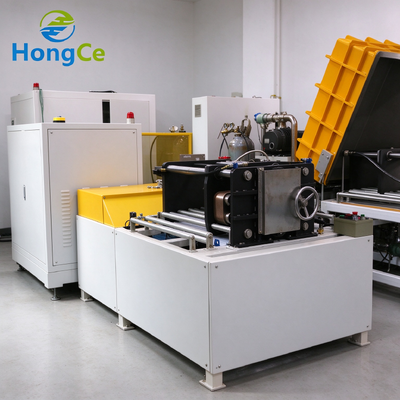
If you braze plate heat exchangers for chillers or heat pumps, this is the machine that decides whether a weeping core leaves your plant. Two chambers, a gross-leak pressure stage in front of the sensitive stage, and a recovery loop that keeps the running cost honest — sized to your core range, not to a catalogue envelope.
A brazed core has no gasket and no bolts. Once it leaves the furnace, the only thing standing between your customer and a refrigerant leak is the braze itself. That is why the failure mode is so expensive: nobody can repair it in the field. The chiller comes apart, the core is replaced, the refrigerant is recovered and recharged, and the labour is yours whether the warranty says so or not.
We have been asked to look at enough of these claims to know where they come from. Four places, almost every time:
Every one of those sits below what an air decay test can resolve in a cycle time your line will accept. That is the whole argument for helium on this component — not sensitivity for its own sake, but sensitivity where the failures actually are.
Helium enters at up to 3.0 MPa and the pressure is held for a few seconds before the analyser is even asked to look. A core with an open void is rejected there, in seconds, and the sensitive measurement only ever sees cores that have a chance of passing. It sounds trivial. It is the difference between a 45-second cycle and a 3-minute one.
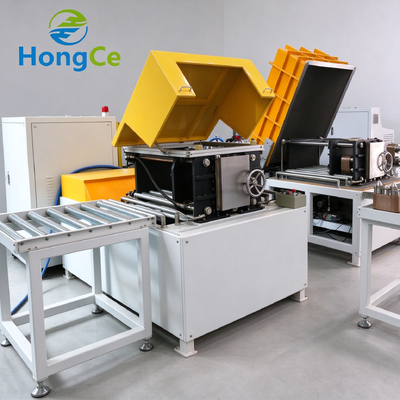
One chamber measures while the other is loaded. The operator never stands idle waiting for a pump-down, which is what makes 100% inspection affordable with one person. A single chamber system with the same sensitivity would need two operators to hit the same output.
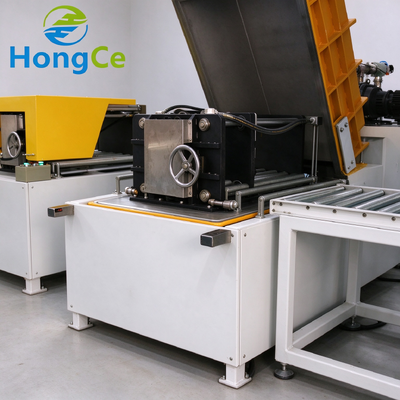
The vacuum is drawn in the chamber, around the core. That matters on a thin plate stack: pulling vacuum through the channels can deform plates and create the very leak you are testing for. Chamber-side vacuum, helium inside the core.
Helium leaves the core and the chamber at the end of every cycle. Without recovery you are venting the most expensive part of the test to atmosphere several hundred times a day. The loop is integrated, with the purification stage after the buffer tank, so the gas that goes back into the core is within specification.
The part of a leak test bench that fails first is almost never the analyser — it is the connector that clamps onto the port four hundred times a shift. Ours are built around your port geometry with replaceable seals, and the seal part numbers are on the drawing so you can stock them.
| Item | Specification |
|---|---|
| Machine configuration | Two chambers, phase-shifted, pneumatic lid and port clamping, skid-mounted |
| Chamber internal size | 800 × 700 × 550 mm each, sized to your core range |
| Minimum detectable leak | 1.0×10⁻⁹ mbar·L/s |
| Gross leak stage | 0.1 – 3.0 MPa helium charge with pressure hold and automatic abort |
| Cycle time | 45 s to 55 s per core, depending on plate count |
| Throughput | About 120 cores per hour with one operator |
| Helium recovery | ≥95%, integrated recovery and purification loop |
| Vacuum system | Roots pump plus rotary vane pump per chamber, oil filtration included |
| Control | PLC with 15-inch HMI, 100 recipes, multi-level password access |
| Traceability | Barcode scan, per-core result log, MES upload over Ethernet |
| Calibration | Automatic sequence with built-in calibrated leak, 12-month interval |
| Power supply | AC 380 V, 3-phase, 50/60 Hz, 18 kW |
| Compressed air | 0.6 MPa dry, oil-free, 300 L/min |
| Weight | About 2600 kg |
| Test item | Typical defect | Why the factory test misses it |
|---|---|---|
| Port collar braze | Voids, incomplete flow | Holds at low pressure, opens under cycling |
| Edge bar joint | Lack of braze two or three plates in | Invisible from outside |
| Plate wall at inlet | Erosion thinning, pinholes | Leak rate below air-test resolution |
| Furnace braze quality | Cold zones on the belt, oxide inclusions | Part looks perfect |
| Port adapters and threads | Under-torque, damaged thread | Only leaks under thermal load |
| Repaired cores | Repair that did not close the leak | Needs a measurement, not a bubble |
Most arguments between a machine supplier and a customer happen here, so this part is worth getting right before the machine arrives.
| Method | Detectable band | Cycle | Effect on the core | Where it belongs |
|---|---|---|---|---|
| Two-chamber helium, this machine | 1×10⁻⁹ mbar·L/s | 45–55 s | Dry, chamber-side vacuum only | 100% final inspection |
| Air pressure decay | About 1×10⁻³ mbar·L/s | 2–10 min | Dry | Cheap gate for gross defects only |
| Water immersion | Gross leaks only | Minutes | Water trapped between plates | Never on a brazed core |
| Helium sniffer spray | 1×10⁻⁷ mbar·L/s | 3–10 min | Dry | Locating a failure, not inspecting production |
| Sample testing in a lab | Best in class | Days | Dry | Design validation, not production control |
A brazed core cannot be immersion tested and then dried. Water sits in the channels and destroys the thing you were protecting, which is why this industry moved to helium in the first place. Once you accept that, the question is only whether the machine can keep up with your line — and that is a question about cycle time and helium cost, not about sensitivity.
One, within the chamber envelope. The recipe changes with internal volume — a 200-plate core needs a longer fill and stabilisation time. We set up a recipe per core and the operator selects by barcode, so there is no manual parameter entry on the line.
Because pressure alone tells you about burst strength, not about a 10-6 mbar·L/s weep. A core can hold 3 MPa for ten minutes and still lose its refrigerant over two seasons. The pressure stage is there to catch gross failures quickly, not to replace the measurement.
With recovery running, the losses are dominated by the port connections and the venting step rather than the core volume. Customers on chiller cores typically report a few litres per hundred cores. We quote the figure for your core size instead of an industry average, because the average is meaningless at this scale.
No. A chamber test is pass or fail by design — finding the leak needs a probe. Keep a portable detector at the rework bench: a two-minute sweep around the collars usually decides between repair and scrap.
Then the test will read high until they dry, because water in the channels outgasses under vacuum. Either test before the water test, or add a drying step. We size the pump set for the wet case when a customer tells us about it up front.
No. The chamber is the envelope; the connectors and the recipe are the part-specific bits. A new core usually means new connector faces and a new recipe, which is a few days of work rather than a new machine.
Half a day of your quality engineer's time for the repeatability study, an operator available for training, and dry compressed air at the station. We bring the calibrated leak and the correlation procedure.
About 85 working days for a two-chamber system with port tooling. The chamber and the connectors are built to your core range, so the earlier we have the drawings, the firmer that date stays.
We have been building leak detection and electrical test equipment in Guangzhou since 2003, with 50–100 employees and roughly half of our output exported to Europe, North America and Southeast Asia. Our engineers commission vacuum chamber systems, tracer gas hoods and air decay testers, so the method recommendation you get comes from production data rather than from a catalogue.
Every system is assembled, pump-down tested against a calibrated leak and recorded under its serial number before shipment. Years later, when you want to know whether a new result is comparable to the original acceptance data, we can still answer.