| Brand Name: | HongCe |
| Model Number: | HC-MTB200 |
| MOQ: | 1 Set |
| Price: | Negotiation |
| Payment Terms: | L/C,T/T |
| Supply Ability: | 3 Sets per 1 months |
EV Powertrain Test Bench for E-Axle Performance, Motor Torque, Speed & Efficiency Testing
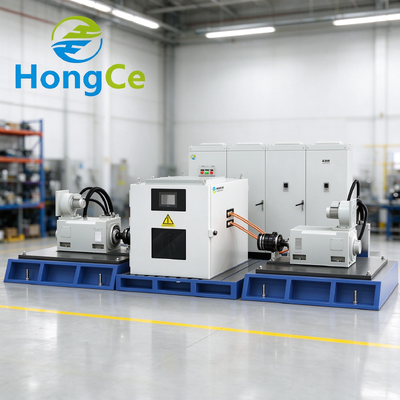
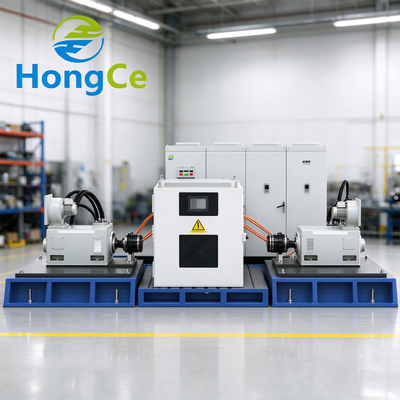
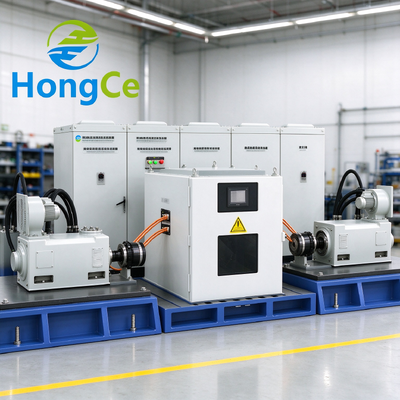
The Electric Vehicle (EV) Powertrain Test Bench is designed for comprehensive performance evaluation of EV drive assemblies, including drive motors and integrated electric drive axle systems. The system enables the assessment of key mechanical and electrical performance metrics under controlled operating conditions, helping automotive manufacturers verify product quality, enhance development efficiency, and ensure consistency in testing standards. It can be customized to accommodate various powertrain configurations, specific testing requirements, and diverse laboratory application scenarios.
An "e-axle" (electric drive axle) is more than just a conventional motor assembly; it integrates various power transmission and control components into a single, compact system. Subtle variations in parameters—such as torque output, rotational speed, transmission efficiency, or thermal characteristics—can significantly impact the overall performance of an electric vehicle (EV).
Evaluating these characteristics cannot be achieved by testing individual components in isolation. A comprehensive test solution is required to assess the complex interactions between the motor, the controller, and the mechanical transmission system under controlled operating conditions.
An EV powertrain test bench provides a dedicated platform for evaluating the performance of electric drive assemblies. Depending on the chosen system configuration, this platform can support the testing of motors, motor controllers, reduction gearboxes, and fully integrated e-axle assemblies.
By incorporating mechanical loading, measurement, control, and data acquisition capabilities, the system enables engineers to obtain repeatable test results and gain a deeper understanding of their products' operational characteristics.
HongCe is a manufacturer of test equipment with in-house R&D, engineering, and production capabilities. Beyond providing standardized test equipment, we work closely with our clients to gain a thorough understanding of their sample architecture, testing objectives, operating conditions, and specific laboratory requirements.
For e-axle test systems, we offer customized configuration planning tailored to the client's specific testing needs—encompassing mechanical interfaces, dynamometer selection, measurement channels, control functions, and software requirements.
The table below outlines the scope of testing that can be covered by the EV powertrain test bench configured for this equipment. Specific functions depend on the selected hardware, sensors, software, and test accessories.
| Testing Function | Description |
|---|---|
| Torque Measurement | Measures output torque under specified operating conditions |
| Rotational Speed Measurement | Records motor or output shaft speed |
| Power Analysis | Evaluates electrical input and mechanical output power |
| Efficiency Evaluation | Calculates system efficiency from synchronized input and output measurements |
| Torque-Speed Characteristic Testing | Establishes torque-speed performance curves |
| Load Performance Testing | Evaluates operating performance under different mechanical loads |
| No-Load Performance Testing | Evaluates motor operation under no-load conditions |
| Operating Condition Simulation | Reproduces selected operating points and test sequences |
| Motor Controller Evaluation | Supports controller-related performance evaluation when the required interfaces are available |
| Gearbox Performance Evaluation | Supports mechanical transmission performance testing with suitable fixtures and sensors |
| E-Axle Integrated Performance Testing | Evaluates the combined drive assembly under configured operating conditions |
| Temperature Monitoring | Collects temperature data through configured measurement channels |
| Test Data Acquisition | Records relevant electrical and mechanical measurements |
| Automatic Test Sequence | Executes programmed testing procedures |
| Test Report Generation | Organizes collected data into test records and reports |
ISO 21782-1:2023 — Electrically propelled road vehicles: Test specification for electric propulsion components — Part 1: General test conditions and definitions.
ISO 21782-2:2019 — Test specification for electric propulsion components — Part 2: Performance testing of the motor system.
Electrified Powertrain Performance Characterization.
Rotating Electrical Machines.
Converter-Fed AC Motor Efficiency Testing.
Drive Motor System for Electric Vehicles.
| Technical Parameter | Specification |
|---|---|
| Recommended Power Range | 0–300 kW |
| Output Speed Measurement Range | 0–3,300 r/min |
| Output Torque Measurement Range | 0–3,700 N·m |
| DC Test Voltage Range | 0–800–1,200 V |
| Voltage Measurement Accuracy | ±0.01% of reading + ±0.03% of range |
| Current Measurement Accuracy | ±0.01% of reading + ±0.03% of range |
| Electrical Power Measurement Accuracy | ±0.03% |
| Speed Measurement Accuracy | ±1 r/min |
| Torque Measurement Accuracy | ±0.05% F.S. |
| Power Configuration | Customizable |
| Speed Configuration | Customizable |
| Torque Configuration | Customizable |
| Technical Parameter | Specification |
|---|---|
| Recommended Power Range | 0–400–500 kW |
| Output Speed Measurement Range | 0–2,800 r/min |
| Output Torque Measurement Range | 0–20,000 N·m |
| DC Test Voltage Range | 0–800–1,200 V |
| Voltage Measurement Accuracy | ±0.01% of reading + ±0.03% of range |
| Current Measurement Accuracy | ±0.01% of reading + ±0.03% of range |
| Electrical Power Measurement Accuracy | ±0.03% |
| Speed Measurement Accuracy | ±1 r/min |
| Torque Measurement Accuracy | ±0.05% F.S. |
| Power Configuration | Customizable |
| Speed Configuration | Customizable |
| Torque Configuration | Customizable |
| Technical Parameter | Specification |
|---|---|
| Recommended Power Range | 0–200 kW |
| Output Speed Measurement Range | 0–2,000 r/min |
| Output Torque Measurement Range | 0–3,000 N·m |
| DC Test Voltage Range | 0–800–1,200 V |
| Voltage Measurement Accuracy | ±0.01% of reading + ±0.03% of range |
| Current Measurement Accuracy | ±0.01% of reading + ±0.03% of range |
| Electrical Power Measurement Accuracy | ±0.03% |
| Speed Measurement Accuracy | ±1 r/min |
| Torque Measurement Accuracy | ±0.05% F.S. |
| Power Configuration | Customizable |
| Speed Configuration | Customizable |
| Torque Configuration | Customizable |
| Technical Parameter | Specification |
|---|---|
| Recommended Power Range | 0–500–800 kW |
| Output Speed Measurement Range | 0–2,000 r/min |
| Output Torque Measurement Range | 0–20,000 N·m |
| DC Test Voltage Range | 0–800–1,200 V |
| Voltage Measurement Accuracy | ±0.01% of reading + ±0.03% of range |
| Current Measurement Accuracy | ±0.01% of reading + ±0.03% of range |
| Electrical Power Measurement Accuracy | ±0.03% |
| Speed Measurement Accuracy | ±1 r/min |
| Torque Measurement Accuracy | ±0.05% F.S. |
| Power Configuration | Customizable |
| Speed Configuration | Customizable |
| Torque Configuration | Customizable |
Customers communicate directly with the equipment manufacturer, reducing unnecessary communication between multiple suppliers.
Our engineering team can discuss customized fixtures, test procedures, measurement requirements, and equipment configurations.
Different customers have different motor power ratings, shaft interfaces, e-axle structures, and test objectives. We develop equipment configurations around actual project requirements.
From component preparation to equipment assembly and functional verification, the manufacturing process is managed by our own production team.
Customers can communicate with our technical and service teams regarding installation, operation, troubleshooting, and maintenance.
We aim to provide more than a single equipment delivery. Our goal is to support customers as their testing requirements and product development programs evolve.
An EV powertrain test bench is a testing platform used to evaluate the performance of electric vehicle drive systems. Depending on its configuration, it can test electric motors, motor controllers, reduction gearboxes, and integrated e-axle assemblies.
An electric motor test bench primarily evaluates an individual motor. An e-axle test bench is designed to evaluate a more integrated drive assembly that may include a motor, controller, and reduction gearbox.
Yes, the system can be configured for integrated electric drive assembly testing. The mechanical fixtures, dynamometer capacity, electrical interfaces, and measurement modules need to match the actual sample.
Torque and rotational speed measurement can be incorporated through suitable sensors and measurement modules. The measurement range and accuracy are determined by the selected configuration.
Efficiency evaluation can be supported when the system has suitable electrical input and mechanical output measurement capabilities. The calculation method and test conditions should follow the selected technical standard or customer test procedure.
The system configuration can be discussed for different traction motor types, including permanent magnet synchronous motors and induction motors. Compatibility depends on the motor's electrical and mechanical specifications.
Yes. As a direct equipment manufacturer with R&D, engineering design, and production capabilities, HongCe can discuss customized configurations according to customer requirements.