| Brand Name: | HongCe |
| Model Number: | HCVC01 |
| MOQ: | 1 set |
| Price: | Negotiatable |
| Payment Terms: | T/T |
| Supply Ability: | 10 Sets per month |
Iec 60335 Refrigerator Door Durability Tester Plc Control Precision Servo Motor Drive
Product Introduction
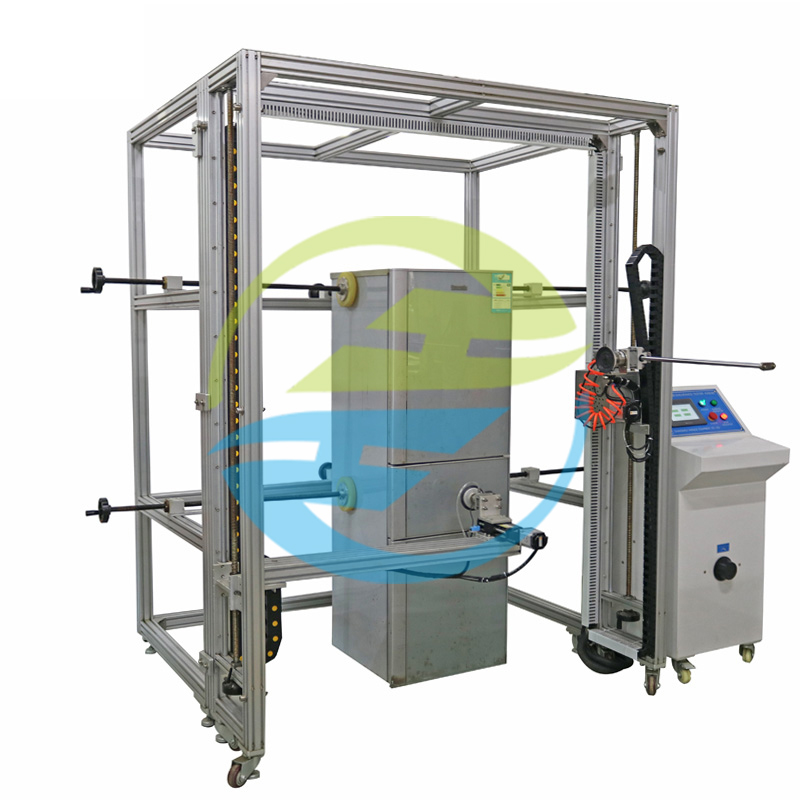
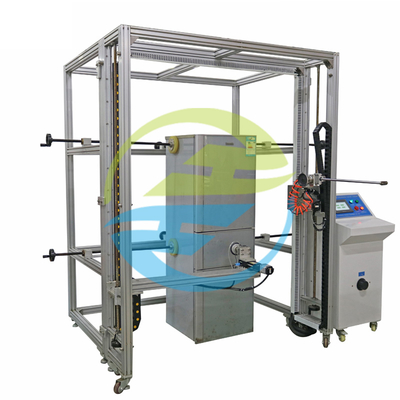
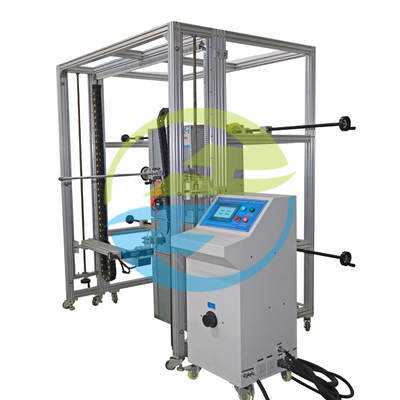
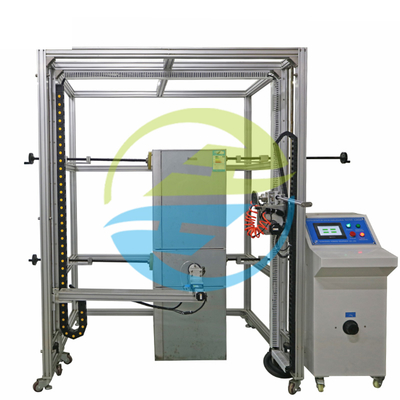
HJ0636C Refrigerator Door Durability Performance Test Equipment focuses on simulating the opening and closing of refrigerator doors in long-term use to verify their structural strength and durability.
Product highlights
International Reference Standards
The design and test functions of the HJ0636C refrigerator door durability performance test equipment strictly follow the following major international home appliance and durability testing standards:
Technical Parameters
|
Parameter |
Measurement Range / Description |
Accuracy |
|
Number of Test Stations |
1-4 (Customizable, for multi-station parallel testing) |
N/A |
|
Test Objects |
Refrigerator doors, freezer doors, wine cooler doors, drawers, etc. |
N/A |
|
Opening/Closing Angle Range |
0° ~ 180° (Adjustable) |
±1° |
|
Opening/Closing Speed |
5 ~ 20 cycles/minute (Adjustable) |
±0.5 cycles/minute |
|
Cycle Count |
0 ~ 500,000 cycles (Settable) |
±1 cycle |
|
Door Load Capacity |
Max. 50 kg (Customizable) |
N/A |
|
Door Size Range |
Width 300 ~ 1000 mm, Height 500 ~ 2000 mm (Adjustable) |
Highly adaptable |
|
Pause Time Setting |
0 ~ 999 seconds (Settable pause time after open/close) |
±0.1 seconds |
|
Sensor Type |
Angle encoder, photoelectric sensor, force sensor, etc. |
High precision |
|
Control System |
PLC control + Touchscreen HMI |
Stable and Reliable |
|
Drive Method |
Precision servo motor drive |
Smooth and Efficient |
|
Safety Protection |
Limit protection, overload protection, emergency stop button |
Comprehensive |
|
Power Requirements |
AC 220V/50Hz (or customizable as needed) |
Stable |
|
Operating Environment |
Temperature 10 ~ 40℃, Humidity < 85% RH |
Standard |
|
Data Recording |
Automatic recording of test cycles, abnormal information, etc. |
Real-time |
|
Overall Dimensions (L x W x H) |
Approx. 1500 x 800 x 2000 mm (Single station, customizable) |
Compact and Rational |
|
Equipment Weight |
Approx. 300 kg (Single station, customizable) |
N/A |
After-sales service
Regular maintenance and calibration: Customized regular maintenance and calibration services can be provided to ensure that the measurement accuracy and operating performance of the equipment are always in the best condition and meet various standard requirements.
Spare parts supply guarantee: Have a complete spare parts inventory system to ensure the timely supply of key components and minimize downtime caused by spare parts problems.
Software upgrade and update: Regularly provide system software update and upgrade services to continuously optimize equipment functions and meet future testing needs.
Warranty service: Provide comprehensive warranty services covering equipment parts and labor, so that you can purchase and use without worries.
FAQ
1. What is the primary purpose of this PLC-controlled IEC 60335 refrigerator door durability tester?
Answer: The primary purpose of this IEC 60335 refrigerator door durability tester (Model HJ0636C) is to simulate the repetitive opening and closing actions of refrigerator doors during long-term use, thereby verifying structural strength, hinge durability, and the reliability of door seals. The equipment is mainly used for quality control on production lines for refrigeration products (such as refrigerators, freezers, and wine coolers), reliability verification during new product R&D, and type testing prior to market launch. By performing tens or even hundreds of thousands of opening/closing cycles, it effectively predicts product service life and identifies potential issues—such as hinge wear, door deformation, or seal aging—in advance. Its programmable test parameters (e.g., cycle count, opening/closing frequency, and dwell time) ensure high precision and repeatability.
2. Which international testing standards does this equipment comply with, and what is its significance for product certification?
Answer: The equipment's design and testing capabilities strictly adhere to multiple international standards, ensuring the authority and international recognition of the test results. Key applicable standards include:
IEC 60335-2-24:2022: This standard outlines particular requirements for the safety of household refrigeration appliances. Clause 22.112 explicitly stipulates that doors, lids, and drawers must withstand a specified number of opening/closing cycles without sustaining permanent deformation, cracking, or safety-compromising failures.
IEC 62552: This standard covers the characteristics and test methods for household refrigeration appliances. It specifies durability test methods for doors, lids, and drawers, as well as requirements for door seal airtightness (e.g., requiring external doors and lids to withstand 100,000 opening/closing operations without compromising airtightness).
EN 60335-2-24 and UL 250: These are safety standards for refrigeration appliances applicable to the European Union and North American markets, respectively; both include requirements regarding door durability.
Compliance with these standards ensures that the equipment's testing methods align with internationally recognized requirements such as CB and CE certification, making it a vital tool for ensuring product compliance when entering target markets.
3. What technical advantages do "PLC control" and "servo motor drive" bring to this equipment?
Answer: The PLC (Programmable Logic Controller) intelligent control system and precision servo motor drive are the two core technologies of this equipment, offering several key advantages:
High Precision and Programmability: Users can flexibly preset parameters—such as test cycles (0–500,000), opening angles (0–180°), opening/closing speeds (5–20 cycles/minute), and dwell times (0–999 seconds)—via the touchscreen HMI to meet the testing requirements of various standards and product types.
Automation and Intelligent Monitoring: The equipment automatically executes preset test sequences and displays progress in real-time. It features current monitoring, fault alarms, and automatic shutdown capabilities; it stops immediately in the event of an overload or sample anomaly, ensuring the safety of both the equipment and the sample.
Data Management: It supports real-time recording and storage of test data and can generate detailed test reports, facilitating quality traceability.
4. What types of refrigerator doors is this equipment suitable for? Can it test drawers and special structures?
Answer: This equipment is highly versatile and adaptable to various refrigerator door structures. Core test subjects include refrigerator doors, freezer doors, wine cooler doors, and drawers. Its technical features include:
Adaptability to Multiple Door Types: By adjusting the robotic arm and fixtures, the equipment can simulate the repetitive opening and closing actions of various refrigerator configurations, such as single-door, side-by-side (left/right opening), and French-door models.
Drawer-style Units: Equipped with specialized fixtures, it performs push-pull cycle life testing on refrigerator drawers with preset travel distances (e.g., 0–100 mm), meeting the testing needs of multi-door refrigerators.
Multi-station Parallel Testing: The equipment supports 1 to 4 stations (customizable), allowing for independent or synchronized testing of multiple doors or drawers, which significantly boosts testing efficiency.
5. How does this equipment simulate real-world usage and ensure the repeatability of test results? Answer: To ensure that test results accurately reflect real-world usage and maintain high repeatability, the equipment incorporates several precision design features:
Standard-compliant motion profiles: The equipment can be configured to execute controlled and free-movement phases during door opening and closing in accordance with IEC 62552 standards—such as allowing the door to move freely after opening to a specific angle—thereby more authentically replicating actual usage scenarios.
Vacuum suction attachment: The system engages the door surface via vacuum suction cups to perform opening and closing operations, simulating manual handling while preventing any additional damage to the door.
High-precision sensors: Integrated components—including angle encoders, force sensors, and photoelectric sensors—enable closed-loop control and precise measurement of motion parameters, achieving an angular accuracy of ±1°.
Stable mechanical structure: A robust design utilizing high-strength materials and industrial-grade components ensures structural stability, effectively suppresses operational vibration, and guarantees data consistency during long-term, high-frequency testing.